
Adaptive Pitch Coach
An AI Voice-Coaching POC for High-Stakes Storytelling
A Product Designer’s Experiment Building with AI
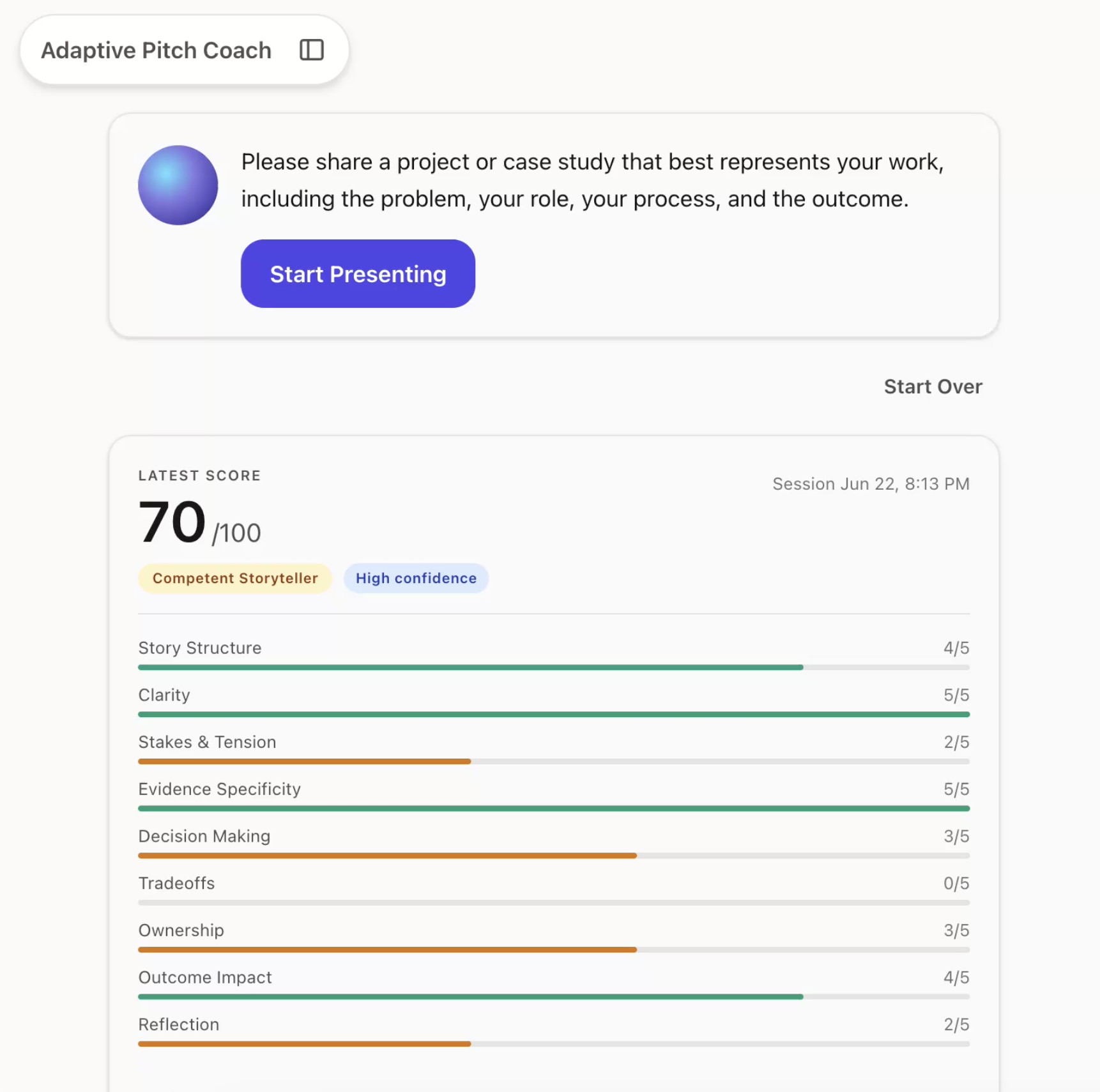
Adaptive Pitch Coach
Adaptive Pitch Coach is a working AI product experiment that helps people practice interview answers, portfolio narratives, leadership examples, and other high-stakes stories.
A user responds to a prompt out loud. The product transcribes the response, evaluates it against a structured storytelling rubric, calculates a rules-based score, and connects coaching feedback to specific moments in the transcript.
Core flow
Prompt → voice response → transcript → AI analysis → validation → scoring → transcript-linked coaching → follow-up practice
My role: Product strategy, UX and interaction design, AI behavior, scoring logic, implementation direction, and experience QA.
I designed and built the POC independently using AI-assisted development to explore how faster implementation changes the role of product design—and where human judgment is still essential.
Why I built it
People often understand their work but struggle to explain it clearly under pressure.
A strong story needs to communicate:
what was at stake
what the speaker personally owned
which decisions were made
what tradeoffs were considered
what evidence supported the approach
what changed as a result
Many AI coaching tools provide broad advice, but the feedback can feel generic or disconnected from the speaker’s actual words.
I wanted to test whether an AI product could listen to a spoken story, evaluate its structure, and provide feedback specific enough to improve the next attempt.
What I built
The POC supports an end-to-end coaching session:
The AI presents a practice question.
The user records a spoken response.
The product transcribes the answer.
The LLM identifies evidence across a storytelling rubric.
A validator checks the AI output.
A deterministic system calculates the score.
Coaching feedback is linked to transcript excerpts.
The AI asks a focused follow-up question.
The rubric evaluates story structure, clarity, stakes, ownership, decision quality, evidence, impact, and reflection.
Product and system challenges
Feedback lacked evidence
Observations such as “your ownership was unclear” did not show users where the issue appeared or how to improve it.
AI output needed constraints
The LLM needed flexibility to interpret different stories, but scoring needed to remain structured, explainable, and repeatable.
Code-level success did not guarantee product success
Features could pass technical checks while still failing in the real experience. Audio might exist but not play, controls might render but remain difficult to discover, or the interface might appear normal while the backend had failed.
The solution
Transcript-linked coaching
Each coaching observation is connected to the user’s own words.
Instead of:
Your ownership was unclear.
The product provides:
Transcript
“We decided to redesign the onboarding flow.”
Observation
The answer describes a team decision but does not explain the speaker’s individual contribution.
Try next
Clarify what you personally proposed, influenced, designed, or decided.
Grounding feedback in transcript evidence makes it more specific, understandable, and actionable.
Validated AI interpretation and deterministic scoring
The evaluation is divided into three layers:
AI interpretation
The LLM identifies evidence in the story.
Validation
A validator confirms that required categories, values, and transcript excerpts are present and correctly formatted.
Deterministic scoring
A rules-based system calculates the final result.
When the AI output does not match the expected structure, the product retries or records a recoverable error instead of silently producing an unreliable score.
This architecture is designed to make feedback more repeatable when the same story is evaluated, rather than allowing the LLM to generate an unconstrained score each time.
Voice-first interaction
The session clearly communicates:
when the AI is speaking
when the user should respond
when recording begins
when the experience moves into analysis
The product behaves like a guided coaching conversation rather than a form with audio controls attached.
What the POC demonstrates
The current build demonstrates that:
The end-to-end voice-coaching loop is technically feasible.
Structured validation can prevent malformed AI output from silently entering scoring logic.
Rules-based scoring can improve repeatability when the same story is evaluated.
Transcript evidence can make AI feedback more explainable and actionable.
Real product use reveals experience-level failures that static designs and code-level checks may miss.
Initial testing indicates improved repeatability, but broader testing is still needed across users, story types, phrasing variations, and speaking styles.
What still needs validation
Consistency and robustness
Test repeated stories, minor wording changes, different speakers, and varied story types.
User trust and usefulness
Evaluate whether users understand the score and find the coaching accurate and actionable.
Behavior change
Measure whether the second attempt improves in structure, ownership, specificity, and impact.
Rubric calibration
Compare product output with expert evaluations to identify dimensions that need adjustment.
What’s next
Test with target users
Run sessions with product designers, product leaders, founders, and job seekers practicing real stories.
Calibrate and stress-test the scoring model
Compare system output with evaluations from hiring managers, interview coaches, and experienced product leaders. Test for scoring drift, over-sensitivity, and contradictory feedback.
Measure improvement
Compare first and second attempts across structure, ownership, specificity, impact, and user confidence.
Strengthen reliability and personalization
Expand automated coverage for scoring logic, validation, transcript matching, failure states, and regression-sensitive workflows. Reintroduce personalization only where it materially changes prompts, coaching, difficulty, or scoring priorities.
Key takeaway
Adaptive Pitch Coach began as a voice-coaching experiment. It became an exploration of how AI products should balance flexible interpretation with structured, trustworthy behavior.
The project showed that faster implementation does not remove the need for product discipline. It shifts more responsibility toward defining system contracts, validating trust-critical behavior, and deciding what evidence is required before scaling.
AI accelerated implementation. Product judgment was still required to define the experience, constrain unpredictable output, verify the complete system, and separate what the POC demonstrates from what still needs evidence.
The current architecture is designed to produce repeatable coaching through validated AI interpretation and rules-based scoring. The next step is to validate that repeatability across a broader range of users, stories, and speaking styles.
© 2026 Mary Ann Saulong Lewis. Adaptive Pitch Coach concept, design, and prototype. All rights reserved.